Smallholder Farmers: Small in Scale, Enormous in Impact
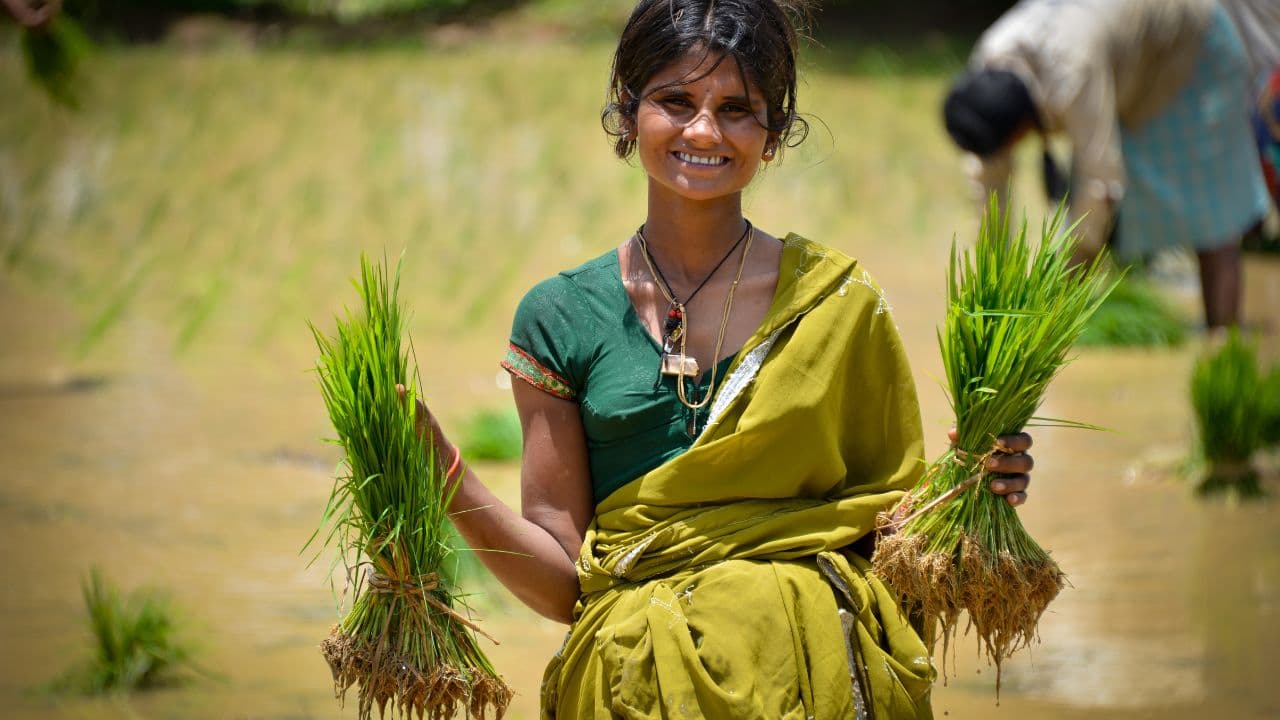
Think of the smallest shop in your neighbourhood — the one run by one family, with a tiny space, but somehow it always has what you need. Now imagine that almost every shop in the country is like this. That is Indian farming in one picture.
Most farmers in India do not own big farms. They own small pieces of land — often smaller than a football field. We call them "smallholder farmers." And even though each one of them farms a tiny piece of land, together they grow most of the food that ends up on your plate.
This is the story of how something small can still be enormous.
How small is "small"?
In India, a "small and marginal farmer" is someone who owns less than 2 hectares of land. To put that in a size you can picture — 2 hectares is roughly the size of 2-3 football fields put together. That might sound like a lot, but for farming, it is actually very little. A farmer growing wheat, rice, or vegetables on this little land has to feed their whole family from it, pay for seeds and fertiliser, and still hope the monsoon behaves.
Indian agriculture is not built on a few large farms. It is built on millions of small ones, standing side by side.
Small farms, huge share of your food
Even though their land is small, smallholder farmers together produce a huge share of India's food — a large part of the rice, wheat, pulses, vegetables, milk, and fruits you eat every day comes from these small farms, not from big commercial ones.
Think about it this way: if a hundred people each grow a small vegetable garden, together they can produce more vegetables than one person farming alone on a huge field. That is exactly what happens across India, just multiplied by millions of families.
This is why, even when you hear about big farming companies or large agri-businesses, it is still the small farmer, working a tiny plot near a village you've probably never heard of, who is quietly keeping the country fed.
The hard part: farming small is not easy
Having a small farm sounds simple, but it actually makes life harder for a farmer, not easier. Here's why:
- Less bargaining power. A farmer with a small harvest cannot negotiate a good price the way a big farm can. They often have to sell at whatever price is offered that day.
- Harder to get loans. Banks are usually more comfortable lending to bigger, established farms. A smallholder often has to depend on informal lenders who charge much higher interest.
- No safety net for bad years. If the monsoon fails or pests destroy the crop, a big farm can absorb the loss. A small farmer, growing food for their own family's survival, cannot.
- Expensive machines, tiny land. A tractor or a harvester is built for big fields. It doesn't make sense — or fit in the budget — for someone with less than 2 hectares.
So the same small size that makes these farmers so important to India's food supply is also what makes their life difficult.
How things are slowly changing
Farmers are teaming up. Groups called FPOs (Farmer Producer Organisations) let hundreds of small farmers join together — almost like a small farmers' club. Once they combine their harvest, they can negotiate better prices, buy seeds and fertiliser in bulk at a lower cost, and even own shared equipment that no single farmer could afford alone.
Machines are shrinking to fit small farms. Instead of giant tractors, companies now design smaller, lighter machines — power tillers, mini reapers, small weeders — that actually fit a 1-2 hectare farm and a family budget.
Phones are becoming farming tools. A basic smartphone can now tell a farmer the weather forecast, market prices in the nearest town, or how to treat a crop disease — knowledge that used to require traveling far to ask an expert.
More support from banks and government schemes. Programs today are increasingly designed with the small farmer in mind — smaller loans, crop insurance, and subsidies that a 1-hectare farmer can actually use, not just a large landowner.
Why this matters to all of us
Even if you have never set foot on a farm, smallholder farmers matter to you directly. The rice in your rice bowl, the vegetables in your curry, the milk in your tea — a large share of it most likely passed through the hands of a farmer working a small plot of land somewhere in India.
Small farms are not a weakness in India's food system. They are its backbone. Millions of small efforts, added together, become something enormous — enough to feed over a billion people, year after year.
The next time someone tells you that "small" cannot make a big difference, think of the smallholder farmer. Small in land. Small in machines. Small in bargaining power.
But absolutely enormous in impact.
Where AgPro fits
At AgPro, a large part of our work — from farm mechanization to farmer producer organisations — is about making sure small farmers get access to the same tools, markets, and support that bigger farms take for granted. Helping a smallholder farm run better is not a side project for Indian agriculture. It is the main project.
Explore market expansion & channel →Quick answers.
- In India, a farmer who owns less than 2 hectares of land is classified as a small or marginal farmer — marginal being under 1 hectare, and small being between 1 and 2 hectares. Roughly 2 hectares is about the size of 2-3 football fields put together.
- Small and marginal farmers make up roughly 85-90% of all farmers in India — meaning out of every 10 farmers you meet, 8 to 9 are working less than 2 hectares of land. They are the large majority of Indian agriculture, not a small niche within it.
- Small landholding size makes it hard to get a good price for a small harvest, hard to get bank loans compared to bigger farms, hard to absorb losses in a bad year, and hard to afford large machinery built for bigger fields. The same small scale that makes them numerous also makes each individual farmer more vulnerable.
- Farmer Producer Organisations (FPOs) let small farmers combine their harvest and bargaining power. Smaller, lighter farm machinery is being designed to fit 1-2 hectare farms. Basic smartphones now give farmers weather forecasts, market prices, and crop advice. And government schemes increasingly offer loans, insurance, and subsidies sized for a small farmer rather than only a large landowner.

Devendra K Jha· Director, AgPro Consulting
Founding Director of AgPro Consulting. Agricultural engineer with 28+ years across agri inputs, mechanization, and enterprise leadership roles.
LinkedInRelated insights
Regenerative Agriculture in India: Farmers Don't Sell Soil Health, They Sell Food
Regenerative and natural farming are gaining ground across India, but the pitch built for policymakers and investors — soil carbon, biodiversity, ecosystem services — is not the pitch that sells a vegetable. Here's why the language has to change, and what actually works with Indian consumers.
Is Biomass Really Carbon-Neutral? The Science — and Where the Claim Breaks Down
Biomass is called carbon-neutral because the CO2 released when it burns was pulled out of the atmosphere by the plant while it grew — in principle, a closed loop. That loop only holds under specific conditions, and for anyone building or financing a biomass energy project in India, the gap between the textbook claim and the bankable reality is where the real work sits.
State-Wise Cropping Patterns: What Changed in India's Foodgrain Map in 2024-25
Uttar Pradesh retook the rice leader position in 2024-25 after Telangana led in 2023-24. The wheat map held, but the within-state mix shifted. This piece walks the state-level production numbers — and what they mean for anyone planning agri-input demand or supply-chain flows in 2026.